


Page 12 - ABF Newsletter February 2026
P. 12
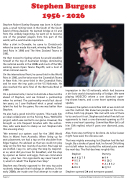
Stephen Burgess 1956 - 2026
Stephen Robert Stanley Burgess was born in Kaitan- gata, a small mining town in the South of the South Island of New Zealand. He learned bridge at 15 and from this unlikely beginning, he went on to become one of the greatest players from this part of the world, with a world-wide reputation.
After a stint in Dunedin, he came to Christchurch where he soon made his mark, winning the New Zea- land Pairs in 1980 and The New Zealand Teams in 1981.
He then moved to Sydney where he would establish himself at the top of Australian bridge, dominating the national events in the 1980s and much of the 90s, winning seven Open Teams Playoffs, and a host of other national events.
On the international front, he came third in the World Pairs in 1986, and he twice won the Cavendish Teams in New York. He came third in the Cavendish Pairs, and he won the imp pairs at the US Nationals. He also reached the semi-final of the Bermuda Bowl in 1989.
On a personal note, I came to Australia a few months ahead of Stephen, and we formed a partnership when he arrived. The partnership would last about ten years, so I saw firsthand what a great natural talent he had for the game. No one was better than Stephen.
He also had a good mind for system. This made him an ideal collaborator on the Forcing Pass / MOSCITO project, which was central to our game. However, this brought us into frequent brushes with the author- ities, who were keen to stamp us out. Stephen tells this amusing story:
“We entered our system card for the 1986 World Pairs in Miami from Australia. When lining up for seat placement, we had a tap on the shoulder from Edgar Kaplan. He advised us that we could not play relay on the first two rounds of auction. Paul says we are stuffed. I say no. Let’s play the step by respond- er as, what did you have for breakfast, and the step by opener as bacon and eggs, then we commence relay – plus two. Our opponents say never heard of it, what’s it called? The Kaplan Two Step.”
Stephen was fiercely opposed to the way top pairs routinely telegraph their holdings in defence. In the early 2000s, we made one final attempt to make an
Page: 12
impression in the US nationals, which had become a de facto world championship of bridge. We were playing MOSCITO where a one diamond open- ing shows hearts, and a one heart opening shows spades.
However, the system committee told us we could not use this method. We knew two people on the com- mittee, both top players. We met with one of them to try and sort it out. Stephen said what if we tell our opponents to treat a one diamond opening as if it were a one heart opening. Committee Man (let’s call him CM) replied, what if goes one diamond, pass, pass?
Alas, there was nothing to be done. As Julius Caesar might have said, the die was cast.
That was mighty annoying, but Stephen had the last laugh. By a stroke of good luck, he found CM sitting on his left when he started the national pairs event the next day. The first deal was roughly this:
Stephen Dummy
]AKQ73 ]94 [953 [K102 }76 }AJ832 {863 {Q92
Stephen opened 2] and everyone passed.
Australian Bridge Federation Ltd. Newsletter: February 2026


