


Page 15 - ABF Newsletter February 2026
P. 15
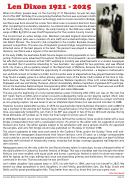
Len Dixon 1921 - 2025
When Len Dixon passed away on the morning of 17 December, he was ten days short of his 104th birthday. It is unsurprising therefore that Len was a pioneer in both his chosen profession (information technology) and his chosen recreation (bridge).
Len Dixon was born around the corner from Brick Lane in London’s East End. Soon after completing his secondary education, he entered what was to become known as the IT industry, then in its infancy. His early training in the field was under the wings of IBM. By 1955 he was Chief Programmer for the London County Council.
The Council had an active bridge club. Members included England international Derek Rimington (who was a member of Len’s staff) and acclaimed bridge colum- nist Albert Dormer. The Council’s club competed in the London Business Houses pennant competition. This was one of England’s premier bridge competitions and attracted some of the best players in the land. The pennant was played in several divisions. Len Dixon was a regular in the second division.
In the early 1960s, the Australian Public Service began recruiting specialists in com-
puting. Positions were advertised throughout the British Commonwealth. Len and
his wife Ruth (pictured above at their 1947 wedding in London) saw advertisements in a London newspaper and decided that it would be interesting to “see Australia”. Len applied for two positions, and was offered both. His chose a job as systems analyst in the Department of Defence, because that department made a slightly better offer that included the opportunity to complete tertiary education – a degree in mathematics.
Len and Ruth arrived in Canberra in 1962, but 12 months were to elapse before they played duplicate bridge. They found a weekly game in a rather gloomy upstairs room of the Burns Club, located at the time in Can- berra Avenue. They met Maureen and Val Ackerman, Wallace Caplehorn, Olive Lott, Julian Makowski, Kay Poplawski and Lew and Shirley Thomson. Almost immediately, Wallace Caplehorn organised ACT’s participa- tion in the Australian National Open Championship (ANC 1963) in Adelaide. The ACT team was Len and Ruth Dixon, Val Ackerman, Wallace Caplehorn, A Garrett and Julian Makowski.
This was just the beginning of a long representative career. Following ANC 1963, Len was on the next five ACT Open Teams at ANCs and on seven occasions subsequently, twice as non-playing captain. Much later, he was a member of ten ACT Seniors Teams at Interstate Championships, eight times as a player and twice as non-playing captain. He was never to win an Interstate Open Teams, but was second in Hobart in 1980.
However, he twice tasted ANC success. In 1970, he was Australian Open Individual Champion, and in 2001 he was a member of the winning ACT Seniors Team. His performance in the final of the 2001 event, against Vic- toria, was especially noteworthy. Len, then in his 80th year, played in two of the six 10-board stanzas. During those 20 boards, ACT picked up 72 imps; the final margin of victory was 27 imps.
In 1968 David Sobell, one of Len’s favourite partners, felt that the Canberra Times could do better with a local bridge correspondent than with a syndicated column. He wrote to the editor with his suggestion and put forward Len’s name. The editor agreed, subject to his satisfaction with some sample columns. He approved the samples, and Len’s first bridge column was published on Thursday 17 October 1968.
The column appeared at least once each week in the Canberra Times and/or the Sunday Times until mid- 2023 when the newspapers discontinued their leisure sections. Len’s 55 years as a bridge correspondent must surely be a record unsurpassed anywhere in the world. Ever a tireless propagandist, Len kept his fellow reporters well informed of newsworthy events, ensuring that bridge coverage appeared well beyond Len’s own columns.
Newspapers were not the only outlet for Len Dixon’s literary talent. In early days, he was a frequent editor of the daily bulletin for Canberra’s Summer Festival of Bridge. This was a thankless task that brought the editor little joy. Len once recalled, with equal pride and horror, a particular festival at which he alone was respon- sible for typing up the copy, editing each issue and organising printing and distribution. Yet most years he continued in the role. That was because he was Len Dixon!
Len’s eldest daughter Sara passed away in 1975, his wife Ruth in 1984, and now Len himself in 2025. We extend our deep sympathies to Len’s daughters, Jo and Felicity, grandchildren Sam, Lily, Ruby, Gracie and Stella, and his great granddaughter Mia. They, better than any of us, know that Len was a great man.
John Brockwell
  Australian Bridge Federation Ltd. Newsletter: February 2026 Page: 15


